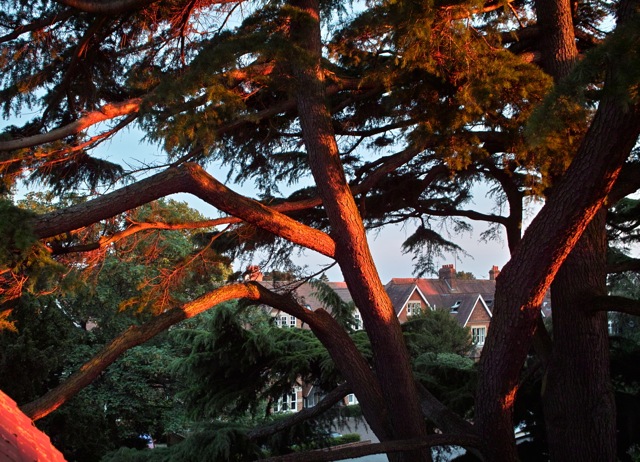
over the banal mechanics of life commerce and costs, then catch sight of the July sunset gilding the cedar. It seems more worthy of study. Perhaps there’s hope for me yet?
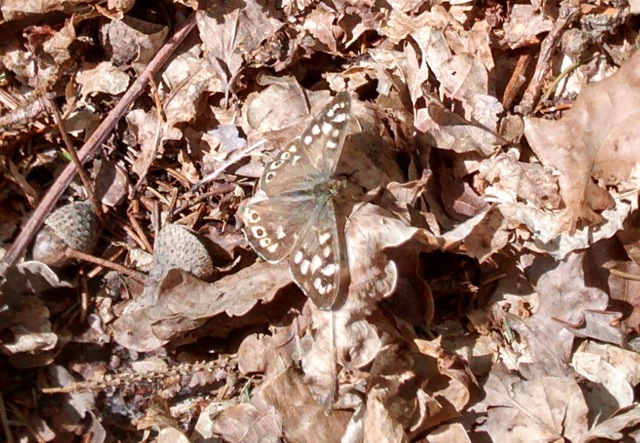
and impulses, the essential forces of life, in ethics, false causes and fine argument. We hide the rough ore of our wishes even from ourselves. And thank the gods for that, else war and will and hate would drive out every tender, untrampling thing from this world. Those rare, other things would be lost to us. Might is not the only right and both sides must take their places at the dance, the battalion and the butterfly.
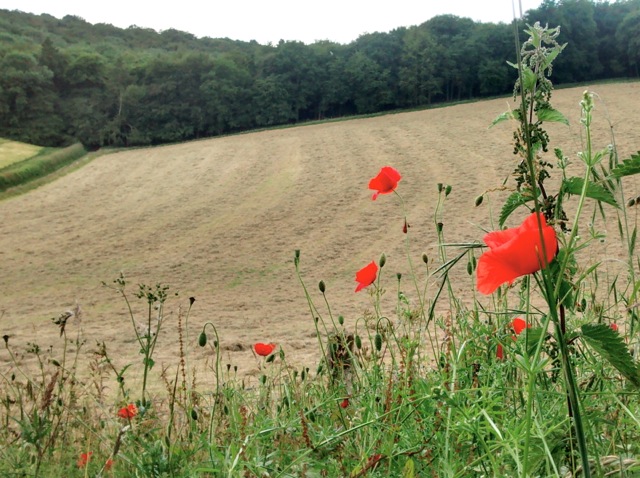
at the wood fringes around Disraeli’s house and grounds. And sure enough, there were old traces of wounds and wars there, combat aircraft motifs on the pathway signs and an ice store bunkhouse converted into a black chamber, where agents once stooped over aerial pics of enemy factory districts. They watched from rumbling bombers seventy years back and now there are shark-grey tubes and fins silent above us, ranks of mobile phone chips in their nosecone cameras recording every moving object, tracking, recognizing, analyzing for threats. All for the good if they can keep us from harm. And what choice do we have but to trust the shepherd? But, a few steps back from the poppies and you’re under the ash and oak canopy, out of sight of the electric eye, free to walk the shaded paths and review the past. Free to imagine and peer at the flickering shapes of the soon to come.
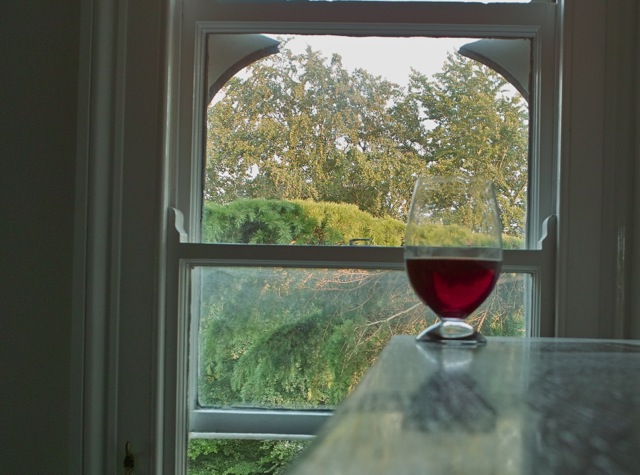
I have a hideaway sanctum. I pass through a low door from my lonely study and down some creaking steps, through a corridor, another twisting staircase and another splintered door, to emerge in shafts of light, a secret, lofty room with a balcony outlook at the far end of the planks, a high view of the city. And in the room, a glass of Irouleguy waiting in the train diner glass and a copy of Robert Graves’ war poems and maybe a sofa, for lounging and recuperation and reflection. And maybe other discoveries attend in this room, the answers to arcane queries and yelps? Could I write a coded language with all the pushed-down things I yearn to ask, and would the people I want to, understand it, would they see through the tangle and would it touch their hearts, would they care? When you tap words, how can you know the readers and hopes you’ll brush up against, if only a lonely few, all dreaming of their own hidden rooms.
I’d meet a friend, Ranger in Camden. We’d drink in the Bucks Head, the Elephant or the Caernarvon Castle and watch Shakey Vic’s blues band play through to midnight. I was fresh in the city, kept my wordlies of two or three hundred in notes stuffed down the front of my jeans. When it was my turn at the rounds I had to slink to a corner and fumble for the cash. Ranger worked in bank systems and the suit he wore passed through stages of advancing grubbiness and ruin as the evening wore on. We were both tottering and shouting in the blues hall fug, before the traipse back on the Hell Worm to Tooting or Stockwell or whichever quadrant of the town owned our £50 a week rooms. I had shows to play at the weekends, but the weekdays were my own. Free to wander the endless corners and intrigues of the capital.
the track to desired outcomes and futures, does that make them more likely to come your way? I might see myself in different habitats and settings dozens of times through every day, but the abiding, dominant feeling in my own writing life is that not much changes. I don’t lounge in Malibu ocean-front villas with each day dawning as a fresh nibble at everything planet Earth has to offer. I buy a loaf. I pay a cheque in (now and again). I chat with the bookshop owner about how many of his own title he’s sold this week, never more than five or six, but at least he’s selling. I try to work and breathe life into things, most stumble and fall. I understand the allure of grass-is-greener gazing – other places, other faces – but I don’t want to swap the keel and beam of my present life. If I could smash things and start again, I wouldn’t. Here I am trapped in the puzzle, more than content to examine its intricacies, close turnings and mirrored walls.
and rolling by crumbling brick terraces, a glance to the ageing Oxford loons in their once-modest million-pound homes. A couple dead-heading the roses. Holes in the floor and carefully placed rugs, time-travel kitchens and peach bathroom suites, copies of the TLS from the fifties, when there was still something worth reading making it to print. I carry my falafel nugget lunch and a card from Blackwell’s Art Shop, trying to shake the memory of faces, the girl in the deli with the sad eyes and a Queen Wealthow braid, the white-faced youth in his sackcloth cassock – where was he going, what high-walled holy quod does he call home? Another hour lost and no progress made, not even a paragraph pushed out. Beat it home and resist the wood panels and golden foam of the Gardeners. Nod hello to the Monkey Puzzle tree on Warnborough and pick up speed, three hours to write, three hours my own.
at the tower and spied the bible-black streak of the canal boat, wrapped in a copper-green winter shroud. Oxford’s oddballs don’t shout and boast, they hide away on Folly Island and the green tunnels of the river twists with their imported gondolas. I might have to buy a stand-up paddleboard and perfect the art of reading MacNeice, nonchalant, between elegant strokes. Oxford river cranks, I salute you.
I understand why some might posit a universal design. Why daffodils? Why sand patterns after the tide? Why dragonflies as blue as the June canopy, skimming the grass between my steps? But I’ve seen beauty staring back at me from broken-down bus windows and supermarket queues, scattered in slums and salons and fetid street corners, beauty beyond any guessing or rule. It’s an accident of alignments, angles and tones – and most striking when it appears with no warning or link to its surroundings. Beauty doesn’t feel part of any cosmos blueprint, it’s a supernal trespasser at the commoners’ ball.